This is part of a letter I wrote to a friend
__________________________________________________
Current events. Catalonia/Spain
My view
It is quite sensible the perception the Spanish state has been in a constant crisis for what looks like centuries. That is mostly due to the fact historians tend to write about events, situations or conflicts bound to be interpreted as “crisis” because they seem to emerge at one point in time. They are presented with some antecedents, a description of the event and perhaps whatever outcome ensues.
That is history as written. But history is a continuum, every day following the previous day and giving place and time to the next. Flows with time, carries away with people, their surroundings and values with no loss of continuity. Even when some dramatic, specific event takes place, such as the birth or death of someone, a battle or a natural disaster, the day before and the day after may carry just as much significance.
To put it simply, I have the feeling that history should be less about what happened and more about “what was going on”.
Looking back to the past two centuries, what is now the Spanish state, also named with more or less accuracy Spain, has certainly undergone a succession of events and situations that amount to can well be considered a continuous crisis. That represents mostly the incapacity for resolving previous problems and the lack of foreseeing what was coming ahead.
The Kingdom of Spain did not get legal status (de jure, 9 June 1715) until three centuries ago. The Spanish state, as a nation-state did not come into formal existence until the last decades of the 19th century. Other than that, there is a constant confusion about what is the territory, the nation or the country. For all intents and purposes, the current legal status, the statehood arises from the proclamation of the new constitution in 1978. That confusion wears some weight on the interpretations of history.
Reluctantly though, I will refer to the Spanish state as “Spain”.
Again the last two centuries represent the repeated missing of opportunities to stabilize the Spanish society. The Napoleonic war was an opportunity, but the restoration of the Bourbon monarchy impeded the experience of the democratic revolutions such as the United States (1776) or the French Revolution (1789). The dynastic wars known as The Carlist Wars and the turmoil around them had Spain miss the industrial revolution by mid 19th century. The Russian Revolution influenced the last few months of the II Republic (1936) and the following months of the Spanish Civil War, but was bloodily crushed by Franco fascist dictatorship.
Not that revolutions on themselves are all that desirable and around them, there is usually a lot of suffering. But in many other countries set up a starting point for new realities.
I do not think it will be taken as a Marxist theory to try to understand the continuum of crises as the effect of class struggle. In fact, in Spain, social differences have always been extremely harsh. Aristocrats, the educated, the wealthy and the more or less powerful have always been very contemptuous and disdainful of the poor people, “el pueblo llano”. The existence of social categories such as the “hidalgo” represents a way of putting a distance with the others. Arises from the long struggle with the Muslim, and the genocidal repression of the Spanish Jewish population in the 15th and 16th centuries. “Hidalgo”, contraction of “hijo de algo” actually means “son of something”, not the son of somebody. Of something an ancestor might have done or own, mostly something to do with war actions, very often lost in the fog of the past. And that gave a status that allowed to do nothing. To work has been considered, and in some circles still is, a curse to be avoided. And no just manual work. To do business, make deals and other activities were look at as demeaning. Something to do by the Jews. I still remember an elderly member of my family disdainfully referring to businessmen as “mercaderes”, in the Biblical sense of the merchants expelled from the Temple by JesusChrist…
With America colonisation and the rise as an empire, Spain lived on what is remembered as “El Siglo de Oro”, the Golden century, while they were living off the imperial revenues and do nothing but war against other Europeans for religious reasons.
All this while, four long centuries, the lower classes were abused and maintained in the most horrendous poverty. Particularly the peasantry in Southern Spain, suffering recurrent famines, living in boxwood huts or even caves, illiterate and just working temporarily to eke out a miserable life, and that up to times as near as the ’60s of the past century. Most of the recurring internal wars of the past two centuries had an underlying cause in the tremendous social situation of the poor classes.
All that, however, was somewhat different in Catalonia, the Northeast corner of the Iberian peninsula.
While in Spain successive monarchies ruled, the Catalans had managed to create some “predemocratic” civil political institutions such as the “Generalitat” (founded in 1283) and, in Barcelona the “Consell de cent”,(f. 1265) the “Council of the hundred” in the Middle Age. Although subsidiaries of the Spanish (Kingdom of Aragon and Castille), retained some power, particularly collecting taxes. From those days arose a growing economic activity of pre industrial manufacturing of good (ironworks, foundries, textiles…) that allowed the Catalans to ride along the industrial revolution of the second half of the 19th century.
The Catalans in the wake of some of the class struggles of peasants against the wealthy, la “Guerra dels segadors”, the War of the Harvesters, managed to create the first republic of modern ages: the “Republica Catalana”, proclaimed by Pau Claris in 1638. The experiment was crushed by the Spanish armies, but that left a memory still present in the official Catalan national anthem “Els segadors”. (Incidentally, the Spanish state anthem has no lyrics. How about that?)
A major contribution to the Catalan “Renaixença” (rebirth), that is: the recovering of the Catalan own sense of identity around the change of the 19th to the 20th century, were the activities generated by the “Mancomunidad”, the common government agreement of the four provinces of Catalonia (Barcelona, Girona, Lleida and Tarragona). It created schools and cultural institutions, helped to normalize the Catalan language and got a healthy cohesion of the population.
Although the movement was suppressed by the first Dictatorship (1923-1931) and cast into oblivion by the second (Franco’s, 1939-1978), the language and a sense of belonging remained through the years, until the recovering in 1977 of the Generalitat after Franco’s death.
The language
Historically Catalonia has a distinct and specific language: the Catalan. It is a romance language, heir of the latin spoken in the West of Europe, the Langue d’oc, the language of Occident, an ancient language nowadays practically extinct in Southern France, the only remain being the Aranés, spoken in a remote valley of the Pyrinèes, the Aran Valley and recognized as an official language in Catalonia, and thus, in Spain. The Catalan language dates as far back as the 9th century in a written form. Is spoken by some 10 million people in Catalonia, Andorra (where is the one and only official language), Valencia, the Balearic Islands, Southern France, and the city of Alghero on the island of Sardinia, Italy. Close to 10.000 new titles are published every year in Catalan and it is spoken in five TV channels, six newspapers run daily up to 400.000 published and is the 15th language by the number of entries in Wikipedia of the whole world.
The Spanish Central government has been battling the Catalan language as has been done for centuries since at the end of the Secession war in 1715 was banished by the King of Spain. Different governments have continued to do so out of sheer repression, even after the Catalan has been recognized official language of Spain in the current Constitution. As it is now the teaching language in the Catalan school system, the Central government forced the Generalitat to offer specific education in Spanish to the families who wanted it. Out of 1.5 million children in school age, there were only six (6) families taking the offer, four of them recent arrivals in Catalonia. Recent school performance audits (The PRISA study) have shown that Catalan school children had better scores in Spanish language knowledge than those from other areas of Spain who only speak Spanish.
Still for many Spanish politicians and their “choryphaei” media insist the Catalan language “...is a problem.”
The economy (Oh!, yes: ”It’s the economy, stupid!”)
The advance in the industrial efforts and the rise of tourism as an industry during the last third of the 20th century made Catalonia a wealthy and developed society. All that made Catalans somewhat different from the rest of Spain even though was fully integrated into the Kingdom of Spain. Two waves of immigration, in the 1960s mostly from some impoverished areas of Spain, and over the turn of the century from North Africa, the Eastern European countries, and South America have increased the population, although the first wave can be considered fully integrated, and the most recent seems to be on its way to do as well.
A reevaluation of the fiscal reality showed a lot of shortcomings. Catalonia was getting the wrong end of the deal in the fiscal balance as much more was exacted than returned revenues in the form of investments by the Spanish central government. That prompted the Catalan government, up until then integrated into what is known as “the State of Autonomies”, a loose form of government that gave the different regions of Spain some degree of autonomy, to try to reconsider its situation.
The 7.5 million Catalans are 16% of Spain's population of 47 million. But they account for almost 20% of the GDP (PPP). The returns in the form of investments and current public spending fall short every year. It has been figured around 16 billion a year, which is almost ⅓ of the Generalitat year budget. That is what is called the fiscal deficit. Of course Catalonia is a richer community and solidarity would have to get less money back so the other parts of Spain fare better, but the contribution should not exceed 3 to 4%, as happens in other countries such as Germany still helping the poorer East Germany landers after the reunification.
The debt of the Kingdom of Spain is now more than 97% of the annual GDP. The Catalan public debt, calculated separated from Spain is about 34% of its GDP of 93 billion. If Catalonia could obtain a balanced fiscal treatment, it could pay off that debt in just 5 or six years, or getting credits for that amount easily.
The Catalan industries, after the bad treatment they were getting from the Spanish Central government and the economic crisis affecting the Spanish markets, turned to foreign exports and right now up to 65% of the industrial products are exported abroad, and account for almost 40% of all Spanish exports with just 16% of the population.
There is a lot more, but in summary, the Catalan economy could well be a thriving one in an independent situation. There are plenty of studies to show for it. (View Cercle Català de Negocis - CCN).
In the meantime, the Spanish Government has spent 60 billion in support of private banks, build hundreds of kilometres of speed trains hardly used and just as many of superhighways that go nowhere, mostly around Madrid. Barajas (Madrid) and El Prat (Barcelona) airports generate revenues of some 50 billion € each last year. But Barajas got 5 billion in investments last year for a mere 0.124 billion for El Prat.
And what is worse, they have dilapidated the public pension funds. Ths Spanish pension system is the “pay-as-you-go” model. Pensions are paid with the revenues obtained by specific taxes on the employed every fiscal period (a year). The contribution is split between the employer and the employee, but in reality is a part of the salaries cost, so is earned by the employees and paid by the employer. The system, in a growing economy, along the years had produced a hefty surplus close to one trillion euros. That provided a comfortable cushion to afford the growing populations of pensioners originated by the baby-boom of the 1960s. In the years of recession in the first decade of the century, the Partido Popular Central government pulled money from that pension fund up to the point of eating it all up. Right now they are scraping the bottom of the barrel, putting at risk the future of pensions in Spain.
Employment was hit hard during the recent crisis, unemployment hitting a high of more than 20%. The unemployment of the young reached up to 50%. Curiously though, it did not decrease the net immigration from North-Africa and South America of people fleeing from dire economic and social situations in their countries of origin. Somehow the tremendous situation was contained by stretching the pensioners' money who helped out the younger and the growth of black market economy, both undesirable things as that is mortgaging the future.
Once more the economy was sustained by the poor and working classes while banks and the rich lavishly sailed through the crisis with bad investments and the building of structures such as high speed-trains nobody used and superhighways to nowhere, for the profit of big construction companies.
More
In 2006 a new Statute of Autonomy was written, submitted to the approval of the Catalan Parliament, approved by the Catalan people in a referendum, brought to the Spanish Parliament and also approved. Some of the negative votes were from independentist parties interpreting the statute was not enough favourable to the interests of the Catalan people. But before it could get into effect, the Popular Party, then in the opposition, made an appeal against the statute to the Constitutional Court. In order to do that they collected signatures all over Spain under the motto “Contra Cataluña”, against Catalonia. The Constitutional Court is a supervising organ over the Supreme Court, theoretically dedicated to ascertain all the laws abide by the constitution, In those days the Constitutional court (Tribunal Constitucional-TC) of twelve members, way over the mandatory period of six years, had one missing who had died recently, and excluded another because some trumped charges of having written a scientific assay on Catalonia a dozen years before, and thus considered partial to the matter. The votes in the TC were split, five to five, and the president, a known partisan of the Popular Party, cast his quality vote deciding to cut down a sizeable part of the Catalan Statute. The sentence of the TC, published in July 2010, could be interpreted as the initial point of the protracted struggle of the Catalans against the Spanish central government. But by then there was a lot going on.
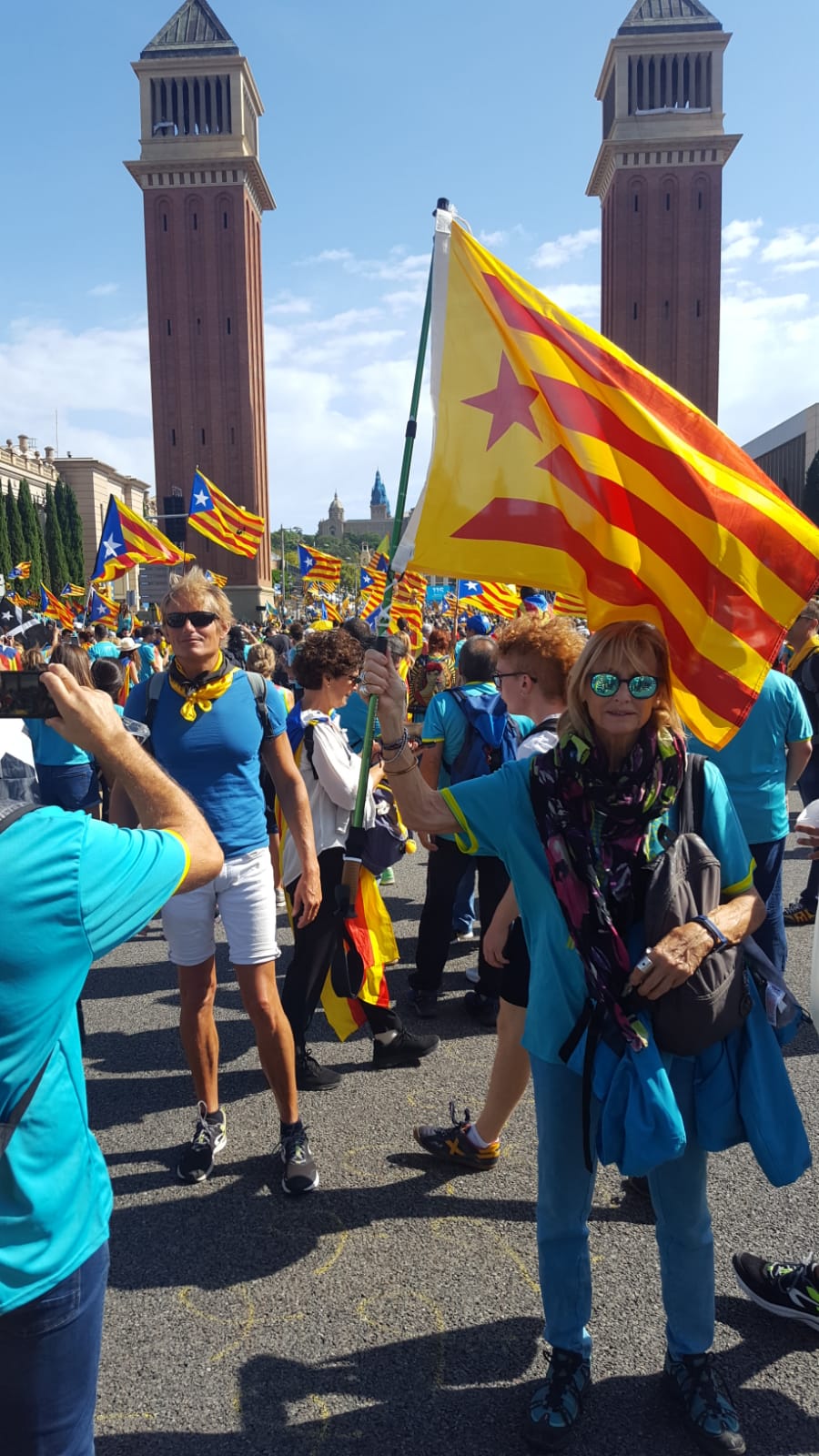
This decision provoked a vast negative reaction in Catalonia. Huge rallies, that put hundreds of thousands of people in the streets of Barcelona, were the beginning of what has turned out to be a push for the independence of Catalonia from the Spanish state. At least two major associations: a cultural one, Omnium Cultural, dedicated to the promotion of the Catalan language, and the “Assemblea de Catalunya”, a non-denominational and trans-party political organization began to organize protests at all levels, concentrating their efforts in huge rallies every September 11, Catalunya National day or “Diada”. These organizations are funded by their members, now more than 200.000 fee-paying members, plus what they get from selling T-shirts of different colours to show well in the aerial views of the demonstrations, and plenty of merchandising trinkets. Every year they put more than one million peaceful and feisty people from all walks of life into the street, that carry on the rally without absolutely not one incident of violence. They chant and shout and wave flags and banners, and end up leaving not one single piece of paper on the ground at the end of the rally. This very civil behaviour makes very nervous the Spanish central government.
All through these years from 2010 the Spanish central government has refused to consider any dialogue or negotiations with their Catalan counterpart.
In November 9th 2014 the Catalan government called an open consultation, as the central government did not authorise a referendum over the independence of Catalonia. That is what in English is known as a straw poll. 2.305.290 voters took up the offer (some 33% of the census) and 80,76% voted in favour. The central government responded indicting the president and some of the members of the Catalan government, put them to trial and they were condemned to heavy fines and banishing them from participating in any elections to public office for 18 months.
The constant negatives of the Spanish government, all these years in the hands of the conservative Partido Popular led, after the elections in Catalonia in the fall of 2015 to the formation of a majority pro-independence in the Catalan parliament. Eventually, the Catalan government of the Generalitat put forward new constitutional laws, approved in September 2017, that led to the celebration of a referendum for the independence of Catalonia the 1st of October of that year.
The referendum was considered illegal by the Central government and the polling stations were viciously attacked by police and paramilitary forces (Guardia Civil) causing more than 1000 injured victims, but they could not impede nor avoid the referendum. 2.3 million voters, 90% in favour of the independence were the results.
The 1-O (2017) marks the turning point of the movement for the independence of Catalonia.
What has been going on in Spain all this while
In a comment sent to The Economist correspondence section in March 2019 I wrote:
...Spain is a highly corrupt state and lacks a solid democracy. The head of the state, the previous king was involved in shady business and a shameless behavior. The current king is also mingled in dirty arms trade with countries at war, something condemned by all international agreements, while enriching himself well beyond taxes. The previous Popular Party was brought down when the first of several ongoing corruption trials came up with a punishing sentence. The Spanish democracy is plagued with legal restrictions on freedom of speech, limitations to free association, police brutality, undue influence of the Catholic church and a legal system mired in incompetence and venality The economic improvements we are starting to see are only for profit of corporations and is mostly due to the excellent output of the Catalan economy that carries the weight of exports and tourism...
Spain has gone over 5 elections for the national Parliament, Las Cortes, in the past for years because the elected parties as a majority have not been able to form a coalition government. Both the Partido Popular staunchly conservative and the Socialist Party, hard to consider leftist or liberal, have failed to sum other parties to reach a majority to form a working government. The vote is fractured amongst at least five major parties, from left to right: leftist Unidas-Podemos, the Socialist (PSOE), the right populist Ciudadanos (C’s), the Partido Popular (PP), conservative right, and the extreme right VOX. To that you have to add the nationalist parties of the Basque Country and Catalonia. That fragmentation of options is due to the difficulties of the parties to offer a good and solid proposition to the electorate.
But the whole thing is also tainted by widespread corruption. The Popular Party government, in power since 2010 was ousted in a censure motion approved by all the other parties after the sentences of some of the corruption trials came out. The Popular Party has more than 1000 officials now indicted or already condemned on corruption charges including a former vice president and minister of Economy. The Socialist party has also a few of the most important leaders in the local government in Andalucia, the largest community of Spain also indicted and most probably to be condemned for mismanagement of public funds. The son in law of the old king ( and brother-in-law of the current monarch) is in jail for embezzlement and corruption. Actually the former king abdicated in a peculiar legal operation as abdication was not contemplated in the Spanish constitution, not for medical reasons, not for his well-known philandering sploits, but because his dealings in arms trade were becoming an embarrassment. That, however, has been hushed by the press. The most publicized episode was his fall and fracture of the hip while he was in a safari trip to kill elephants with his mistress, a German aristocrat with many shady relationships. This evidence of shameful womanizing and the killing of protected species was not as important as the fact that the safari was paid for by Eyad Kayali, a well-known arms dealer from Siria. Trading on arms with a country at war is a serious no-no, isn't it?.
The current king is listed in international magazines of having a personal fortune of more than 1.5 billion. Where that fortune comes from is a matter of speculation, as his hefty yearly stipend of 260.000€ cannot account for it.
Dirty war
At a point in 2017 wiretapped conversations between the Spanish Minister of Interior and one of his underlings delegated in Catalonia, surfaced. They revealed an ongoing plan to undercut the Catalan economy and social system. “We have destroyed their public health system…” was said in one of the captured talks.
Further on, and after the dramatic events in the fall of 2017, many big Catalan business companies were asked to move their central headquarters from Catalonia to Madrid and thus depriving Catalonia of important tax revenues. Even the king Philip VI personally called the CEO’s of a major car manufacturer, SEAT, a subsidiary of Volkswagen, the flagship of the Catalan car industry, to move to Madrid in what is considered an interference in politics and private affairs by the crown.
Accusations of offshore illegal bank accounts of Catalan politicians were publicized, to be proven to be utterly false.
On the 17th of August 2017 a terror attack took place in Barcelona main thoroughfare “Las Ramblas” as a van driven by an islamist terrorist ram and killed 15 people.
This is what I wrote in my blog (La percepción selectiva)at that time:
“Thursday, Aug. 17 a van entered Las Ramblas in Barcelona at about 4.50 p.m. (1450 GMT) and ploughed into a crowd of tourists and local people strolling down the popular walkway, killing thirteen and wounding more than one hundred. Dead and injured include citizens of 34 countries. The driver fled on foot and is yet to be found. A few hours later in Cambrils, 120 km (75 miles) down the coast from Barcelona, five assailants drove a car jumping a police control onto pedestrians and police officers. A Spanish woman was killed. The Catalan police, the Mossos d'Esquadra Police shot dead five people. Soon the perpetrators were identified as Moroccans and the attack was considered jihadist connected.
The terrorist cell perpetrating the attacks in Barcelona and Cambrils kept similarities with the one responsible for the March 11, 2004 train bombings. It involved close to a dozen members and, as some specialists have pointed out, they have an initial plan to build an enormous bomb carried in a big truck, using more than one hundred propane and butane canisters, very popular in Spain as a source of energy for kitchens and heating. They could not rent a truck because they lacked the special driving license needed. Then decided to use two mid-size vans, but in manipulating the explosives in a hideout house in Alcanar, the last Catalan village before Valencia, something went wrong and they blew themselves up, resulting in one dead and one seriously wounded. Today the remains of a third person have been found in the ruins of the house. That happened the day before.
Apparently, without the explosives, they resorted to carrying out the driving-through attack in the Ramblas. There is some coincidence of the hour (17.00) the day the 17th, and the year 2017. The members left, went on and tried a second attack in Cambrils waterfront. Intercepted at a police control, they overrun a policeman and some bystanders, wounding several of them. In their fleeing, they hit some obstacle and the car overturned. The terrorists got out of the car and it was apparent they were carrying explosive vests, later found to be fakes. Then a policeman armed with a long weapon (probably a SCAR-L rifle) shot and killed four of the five occupants of the car, the fifth being killed shortly afterwards by other plainclothes members of the Mossos police. Four possible accomplices have been detained and at least one has escaped and is being the objective of a massive manhunt all over Catalonia.
The third dead body found in the blown-up Alcanar house was later identified as the imam of the Pyrinèes town of Ripoll, and supposed headmaster of the terrorist plot.
There are some strange affairs surrounding the figure of Abdelbaqui-es-Sati, the imam of Ripoll. He had so many police and law infringement records it all smells of an operative agent. Very likely he has been a police informant, probably with the Guardia Civil. It is very strange, having spent four years in prison, freed in 2014, he traveled freely to Morocco, Belgium and Switzerland, and at least once he was spotted taking the hajj to Mecca with a group of youngsters. His name and passport must have raised a red flag more than once. Unless his records were erased or labeled confidential. The Spanish government thus far has failed to give proper explanations of this whole affair, the trials still pending.
The general feeling is that the attacks were a false flag terror attack organised by the Spanish secret services, aiming to justify the deployment of the army in Catalonia to stave off the independence movement. This is not a conspirative theory. They are far to many unexplained things.
The judiciary
In September 2018 I wrote in my blog:
Justice and injustice
The worst thing that can happen to the judicial system is that people talk about it. When people talk about something it is that it does not work as it is. Accustomed to the fact that many instances of the administration have inadequate operations, we are talking about many of them. That the judiciary becomes news should not be desirable. The role that the so-called third power is acquiring in the state shows the ineffectiveness of the other two. The executive, corrupted by the malfeasance of the governments of the Partido Popular, just 100 days ago has changed hands and still retains, although forced by non-easy realities to move, many of the hardships set in the hardcore of the state. The use of gestures that have little effectiveness, not even symbolic as to unearth the dictator Franco, does not make the reality to improve. The legislative power has been in the last 40 years trying to find a non-partisan meaning. When the majorities dominate, the lack of democratic exercise reduces debates to irreparable talk. When the parliament, the place to talk, to parley, is fractured as now, you only hear shouts and calls to advance the elections, to see if this changes the reality. The proper exercise of the controversy in reaching agreements has been a non-existent practice. Only multiparty agreements are reached when it comes to fucking someone, usually people. They have not been able to update the constitutional text more than to change article 135, which places the payment of public debt over the rights of citizens.
The judiciary does not seem like a structure to favor people. Its operation over the past hundred years has had more repressive functions than repairers of rights. The appeal to the justice the Spaniards is always forsaken, perhaps remembering the gypsy curse "Have pleas. And win them. " The corporate prestige of the judiciary is not very prominent. As a group, they generate more fear than confidence. In general, people do their best to stay away and leave formal justice as a last resort. Nor is it that the state has favoured its operation with sufficient material and personal resources. The legal base is obsolete by the century in which we live and the material provision barely exceeds what was normal in other worlds of activity twenty years ago. The technology of communication, archival, and dissemination, is plagued on a daily basis with secrecy, slowness and corporatism, all as a resistance to transparency, modernity or even rationality. This is weighing on prestige.
From an activity like mine, a corporate one, to which I have devoted more than half a century and, according to all the surveys, it appears in the first place of those most appreciated by people, I allow myself to address the group of the jurists and invite them to strive to leave the pit of uncertainty in which, also because of others, they are nowadays.
That the directives on the upper part of the structure have maintained procedures closer to co-optation than meritocracy, it does not help anything. Conservatism, by essence, tends to keep things as they are. And so there is no way to progress.
It is possible that there are also original problems in the training of professionals. To be licensed in law, four years of university education are required. With this and the lack of holders, a twenty-two-year-old jovincell can be a substitute judge, raise corpses, evict families or imprison offenders. To be a doctor, six years of medical faculty are required. And to be an otolaryngologist, or a gynecologist or family doctor, you have to make a difficult exam, as difficult as any official opposition, and to perform four years of formal education. Hopefully, a candidate will be 31 years of age when he can exercise freely. Think about it
Above all, a few incompetent, poisonous, unethical, use impunity for their charges to denounce, insult or threaten citizens who have political opinions other than the highest Spanish nationalism. The sacrosanct freedom of expression, which I hope will protect this text, allows a drunken judge to exercise the "fandango de la pena negra" that he wants to win. But he must know that, as a judge, such a thing disables him to act in any matter that is closer to the defendants or those who share their ideology.
The healthy corporatism, which watches over the good name and the ethics of the corporation, must dispose off the undesirables who forget their obligations and responsibilities ...
The judiciary will have to make many efforts to achieve the trust of its constituents. They need to be replaced as soon as possible. Otherwise they will be far from the people, and what's even worse, of reality.
That said, turning to the judicial system as support of the incapacity of the Central government to deal with political problems is a way of making a disgrace of it all.
The Spanish judicial system is entrenched in ancient legal resources, laws and means, many from Franco's dictatorship era. It is one of the structures have not been through “aggiornamento”, has not been updated. It is a corporate structure as judges are not elected but chosen by co-optation among themselves. In the wake of their supposed independence, they answer to no one. The upper crust, the top structure of the legislative power, the Supreme Council of the Judiciary (CSPJ) is formed by ultraconservative members, many ultra catholic close to the Opus Dei. They elect the members of the Supreme Court.
The recent trial of the imprisoned Catalan political leaders has been plagued with irregularities and procedural misdeeds enough to render it all as a fake trial.
The Spanish “deep state”
The central structure of the Spanish state is an immobilized body that has remained such for the last 150 years. Originated from the aristocracy, it has been a conglomerate of corporative carcass including government and peri-governmental institutions manned by a selective group of people with personal and family relationships. With the years it has been growing to be a sizeable crowd living out of the government. Many may be public officials, but many more are just self-appointed profiteers. It a long list including the government structure of president, ministers, state secretaries, and general directors of departments current or former, the above-mentioned judicial upper crust, the state instituts and councils, the specific tribunals (accounting, taxes, etc.) the “Patronatos”, boards of multiple activities, some royal appointments, the professional General Councils of doctors, lawyers, engineers, researchers and others, in continuous collusion with the large companies that depend on the assignments published in the BOE (the daily official gazette), they form a framework that does not want to renounce power and its privileges of extractive elites.
As an example, some 30 members of the upper officials of the General Accounting Office (Tribunal de cuentas) are family related: fathers, sons, daughters, in-laws, nephews, cousins of each other.
The Armed Forces, the police and the paramilitary of Guardia Civil give support to this nucleus of power.
To all that you may add the big business, banks and investment firms forming the IBEX35, the benchmark stock market index of the Bolsa de Madrid, Spain's principal stock exchange, and the Spanish Catholic church.
The role of the Catholic Church and its governing body, the “Conferencia episcopal”, the bishops' conference, would deserve a specific chapter, left to another opportunity.
*****
This is a rendering of what is going on in Spain. Or, at least, part of it.
This is what the Catalan independence movement is confronting.
Spain is a problem, in some views, a failed state. Unfair and oppressive. The Catalan independence movement is an intent to get away from it all and form a new state. Curiously enough the Spanish powers have decided that the Catalan independence movement IS the problem.
So there we are.
_____________
Current events - Fall of 2019 - Part II
The church
As you know, I spend some of my time at the Reial Societat Arqueològica Tarraconense. Tarragona, the ancient city of Tàrraco is a whole archaeological site of Roman remains. Many of the archeological findings lie under mediaeval and posterior eras buildings and structures. Quite a few belong to the Catholic church, the Archbishopric of Tarragona.
This contact with ancient history brought to my attention a certain reality. One of the greatest lies in European history is the Fall of the Roman Empire. That never occurred. The Roman Empire underwent changes of the seat, of some ways and means, of the method of succession, their religious adscription… but never ceased to maintain its status as an empire. And still has its center in Rome, by way of the Catholic Church.
When Julius Caesar became Pontifex Maximus in the year 63 BC, not even in his wildest dreams could imagine the influence of the empire he was starting to create will reach the whole universe.
The Roman Empire is still there and its head is the Pope. He is even the representation of God in the earth, something Julius Caesar refused three times when offered the crown as a god by his faithful, as the story goes.
So no surprise the Roman Empire (or the Catholic Church version) holds sway in Hispania. The Catholic Church maintains a special agreement, the “Concordato”, that gives all sort of prerogatives and status in the civil society. Even though the Spanish Constitution considers the freedom of religion, Spain may be non-denominational, but by no means is a lay state. Catholic ceremonies preside over all sorts of celebrations, the year calendar follows the Church’s, and symbols of the Church presence abound all over. Half of the names of the towns are Catholic saints, Mother of God figures or other religious representations. By the way that was exported to Texas, from Corpus Christi to San Antonio. That is true for Catalonia as well, from the Seu d’Urgell up North to Santa Barbara, by the Ebro river in the South.
The “Concordato” allows the Catholic Church and its governing body “la Conferencia episcopal”, the bishops Conference, to meddle in education affairs, the shape and form of the legislation, the media (they have their own TV and radio channel) and are represented in many boards of all kinds of institutions. The Church has a special tax exemption and recently has been known they have registered as properties a whole lot of real state around small churches and chapels all over the country in what has been a shameful model of land grabbing. (In Tarragona municipality one-third of the real state and soil belongs to the Church).
The Bishops Conference, an ultra-conservative body has been actively opposing legislation on issues like same-sex marriage, divorce, abortion or euthanasia. At the same time and after the discovery of multiple cases of child abuse and pedophilia among their ranks, they have been diverting the attention of the media and outright censoring news about these matters. Outright supporters of the monarchy and the right-leaning governments, they have used their media and the Sunday Mass homilies to denigrate other political parties.
By the influence of members of the Opus Dei, the Chruch dominates many governing bodies of the civil administration, the universities and the financial sector.
Some of its members have condemned the process for the independence of Catalonia deeming it outright heretical against the “sacrosanct unity of Spain”... OK?
The media
The Spanish media lost its independence and liberty when they could not afford their survival in the middle of the economic crisis. Deeply indebted, they are in the hands of the financial sector, and thus under their power and interests. Public advertising depends on the Central government.
In the matters related to the independence of Catalonia, absolutely all the Madrid media, televisions, newspapers, journals o radios are decidedly against. As are some of the most influential media in Barcelona.
There is no way of following what’s going on in Catalonia by reading El Pais, La Vanguardia or watching the Madrid operated tv channels. They lie constantly, their newsreels and headlines are opinions, not news, and they suppress anything that may help to understand the conflict between Catalonia and the Spanish state.
They exclude any Catalan person, even the pro-Spain, from their tv panels, using some pundits of Catalan origin, but living and working in Madrid, as “representants” of Catalan opinion.
And that is getting worse.
(An example from this week: in an interview on Channel 5, by a Madrid living Catalan anchorwoman, Cristina Grisó, they presented a member of the Guardia Civil supposedly to talk about the difficulties the Spanish police forces are experimenting in Catalonia. To the first question, the man answered that “...he has never held a post in Catalonia, nor lived there…” Aw! Come on!)
To watch Madrid televisions is nauseous.
The sentence in the trial of Catalan leaders
The following is an excerpt of a newspaper article I published last month:
We are still hearing the clams about the post-Franco constitution, the laws and a supposed rule of law by the state and the media at their service. Particularly about the publication of the final sentence of the Spanish Supreme Court on the trial to politicians and Catalan leaders, imprisoned for almost two years in a shameful preventive prison.
The Spanish constitution, a non-removable source of reference, has dystocic origins, written under military vigilance (includes the death penalty) and well-known contradictions. In addition, it has been violated by occasional political conveniences and modified at night and with treachery to satisfy the interests of the most brutal capitalism. Poor law base.
The Spanish Constitutional Court had a modified composition on the convenience of political powers of the moment, the Partido Popular, when it destroyed the new Statute of Catalonia with a deceased member and another excluded for having written a scientific assay about Catalonia ten years earlier. He then used the retention of summaries to please the advantages of the procedural moments and always against the laws approved by the Generalitat. Little reliability.
The Spanish Supreme Court has the habit of appointing itself and manipulating its powers to accommodate political demands. And its more conspicuous members occupy places that do not belong to them, or they feel proud of being able to change the sentences "from behind". They mounted a trial full of irregularities on a summary full of literary creativity of a resigned public defendant, and dismissing testimonials and graphic evidence as if we were still in the nineteenth century. Little justice.
The head of the state, a political descendant of a bloodthirsty dictator, as well as his predecessor constitutionally unimpeachable, would not have to answer to the notorious financial irregularities that surround them. Little legitimacy.
Whatever are the results, the sentence will be appealed in higher courts like the Court of Justice of the European Union (CJEU) in Luxemburg.
XA/Oct, 2019
.


 Posts
Posts


